
What Is an AI Agent? How AI Agents Work for Business in 2026
 Mohit NegiNov 11, 20269 min read
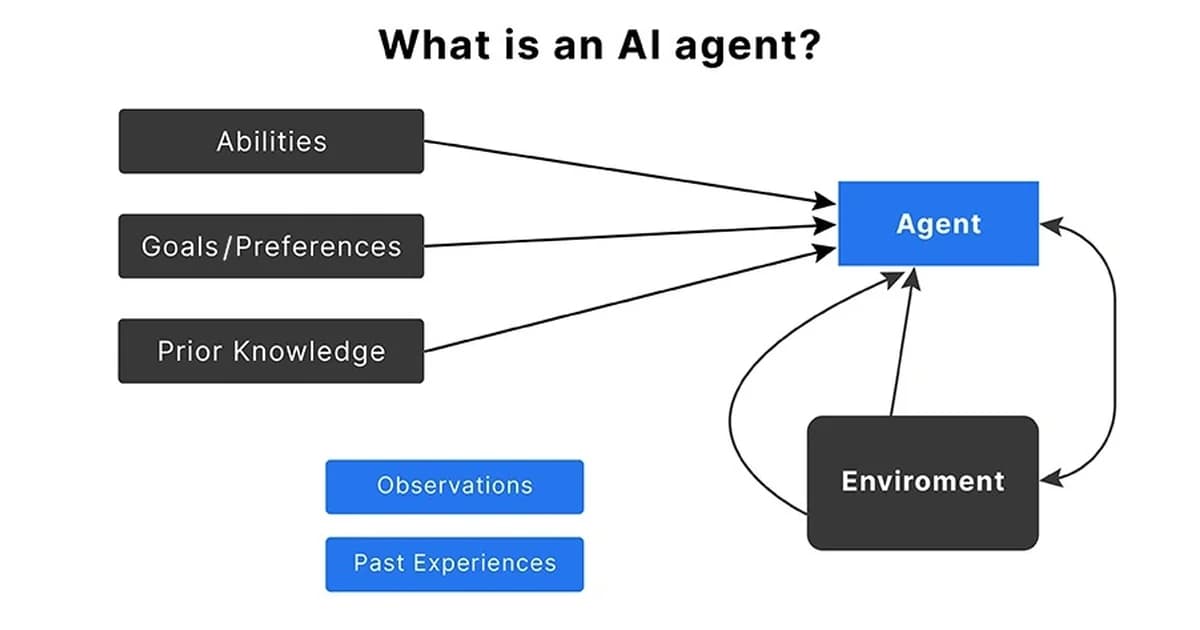
An AI agent is a software program that can perceive its environment, make decisions, and take actions to achieve specific goals, without needing step-by-step human instructions for every task. Unlike traditional software that follows rigid rules, AI agents use large language models (LLMs), machine learning, and natural language processing to understand context, reason through problems, and act independently.
Think of an AI agent as a digital worker that can read emails, answer customer questions, process documents, schedule meetings, or analyze data, all on its own. According to Gartner, by 2028, 33% of enterprise software applications will include agentic AI, up from less than 1% in 2024.
AI agents are already transforming how businesses operate. From automating customer support to managing supply chains, they handle repetitive tasks faster and more accurately than manual processes, freeing human teams to focus on strategy and decision-making.
How Do AI Agents Work?
AI agents work through a continuous loop of four steps:
- Perceive: The agent receives input from its environment. This could be a customer message, an email, a database query, or a sensor reading.
- Reason: Using AI models, the agent analyzes the input, understands context, and decides what action to take. This is where large language models like GPT-4 and Claude provide the intelligence layer.
- Act: The agent takes action: sending a reply, updating a record, triggering a workflow, generating a report, or escalating to a human when needed.
- Learn: Many AI agents improve over time by analyzing outcomes and adjusting their behavior. This feedback loop makes them more accurate with each interaction.
What makes modern AI agents different from older automation tools is their ability to handle ambiguity. A traditional chatbot fails when a question is worded differently. An AI agent understands the intent behind the question and responds accordingly.
AI Agents vs Chatbots: What’s the Difference?
This is one of the most common questions businesses ask. Here’s the key difference:
| Feature | Traditional Chatbot | AI Agent |
|---|---|---|
| Decision-making | Follows scripted rules | Reasons and decides independently |
| Scope | Answers FAQs only | Completes multi-step tasks |
| Learning | Static responses | Improves over time |
| Integration | Standalone widget | Connects to CRM, email, databases |
| Handling complexity | Fails on unexpected inputs | Adapts to new scenarios |
A chatbot can tell a customer your business hours. An AI agent can check inventory, recommend a product based on the customer’s history, process the order, and send a confirmation email, all in one conversation.
According to IBM, businesses using AI agents report up to 30% reduction in customer service costs compared to traditional chatbot implementations.
Types of AI Agents
Not all AI agents are the same. The type you need depends on your business goals:
- Task-Based Agents: Handle specific, repeatable tasks like scheduling, data entry, or invoice processing. Best for businesses starting with AI automation.
- Conversational Agents: Engage with customers or employees through natural language. Used in customer support, HR onboarding, and internal helpdesks.
- Autonomous Agents: Operate independently for extended periods, making decisions and completing workflows without human intervention. Used in supply chain management and IT operations.
- Multi-Agent Systems: Multiple AI agents working together, each handling a different part of a process. For example, one agent qualifies a lead, another drafts a proposal, and a third schedules a meeting.
A McKinsey study found that companies deploying multi-agent systems across departments see 20-30% productivity gains within the first year of implementation.
Real-World Examples of AI Agents in Business
AI agents are not theoretical. Businesses across industries are using them today:
- Customer Support: AI agents handle 60-80% of routine customer inquiries without human involvement. Klarna reported its AI agent resolves queries in under 2 minutes, compared to 11 minutes with human agents (Klarna, 2024).
- Sales and Lead Qualification: AI agents scan incoming leads, score them based on fit, and route high-priority prospects to sales teams. This reduces response time from hours to seconds.
- Document Processing: In healthcare, legal, and finance, AI agents extract data from contracts, invoices, and medical records, reducing manual processing time by up to 80% (Deloitte, 2024).
- IT Operations: AI agents monitor servers, detect anomalies, and resolve common issues automatically. Gartner estimates that by 2026, autonomous AI agents will handle 20% of all IT service desk interactions.
- HR and Recruitment: AI agents screen resumes, schedule interviews, and answer candidate questions. LinkedIn data shows companies using AI in recruitment reduce time-to-hire by 40%.
Benefits of AI Agents for Businesses
Here’s why businesses are investing in AI agents:
- Cost Reduction: Automating repetitive tasks cuts operational costs. PwC estimates AI could contribute $15.7 trillion to the global economy by 2030, with productivity gains being the largest driver.
- 24/7 Operations: AI agents don’t sleep, take breaks, or call in sick. They handle customer queries, process orders, and monitor systems around the clock.
- Faster Response Times: AI agents respond to customer inquiries in seconds, not hours. Harvard Business Review found that companies responding to leads within 5 minutes are 100x more likely to convert them.
- Scalability: Adding capacity means deploying more agents, not hiring and training new staff. An AI agent that handles 100 queries can handle 10,000 with the same infrastructure.
- Accuracy: AI agents reduce human error in data entry, calculations, and document processing. IBM reports that AI-driven automation reduces errors by up to 90% in structured data tasks.
- Employee Satisfaction: When AI handles repetitive work, human employees focus on creative and strategic tasks. A World Economic Forum report found that 77% of businesses plan to reskill employees alongside AI adoption.
Industries Using AI Agents in 2026
AI agents are being adopted across every major industry:
- Healthcare: Patient intake, appointment scheduling, claims processing, clinical documentation. The global AI in healthcare market is projected to reach $187 billion by 2030 (Statista).
- Financial Services: Fraud detection, loan processing, customer onboarding, compliance checks. McKinsey estimates AI could deliver up to $1 trillion in additional value annually for global banking.
- Real Estate: Lead qualification, property matching, document preparation, tenant communication. AI agents help agencies respond to inquiries instantly instead of losing leads to slow follow-ups.
- Retail and E-commerce: Inventory management, personalized recommendations, returns processing, customer support. Businesses using AI in retail report a 15-25% increase in revenue (McKinsey).
- Legal: Contract review, due diligence, legal research, case summarization. AI agents process documents 60x faster than manual review (Deloitte).
- Hospitality: Guest communication, booking management, review responses, upselling services. Hotels using AI agents report 35% improvement in guest satisfaction scores.
How to Get Started with AI Agents
Implementing AI agents doesn’t require a massive budget or a team of data scientists. Here’s a practical approach:
- Identify repetitive tasks. List the tasks your team does repeatedly: answering the same questions, processing documents, updating spreadsheets, qualifying leads. These are prime candidates for AI agents.
- Get an AI audit. Before building anything, understand where AI will have the highest impact in your specific business. Comptech Enterprises offers AI audits that analyze your workflows, identify automation opportunities, and estimate ROI, so you invest in the right areas first.
- Start small. Deploy one AI agent for one process. Measure results. Then expand. Companies that start with a focused pilot see 3x faster ROI than those that try to automate everything at once.
- Choose the right partner. You need a team that understands both the AI technology and your industry. Comptech Enterprises builds custom AI agents tailored to your business, from customer support bots to multi-agent systems for complex workflows. With ISO 9001:2015 certification and experience across healthcare, finance, real estate, and retail, Comptech handles the technical complexity so your team can focus on growth.
- Train your team. AI works best alongside humans, not instead of them. Comptech provides AI training for both technical and non-technical teams, ensuring your staff knows how to work with AI agents effectively.
Frequently Asked Questions
How much does it cost to build an AI agent?
Costs vary depending on complexity. A simple task-based agent can start from a few thousand dollars, while enterprise multi-agent systems with custom integrations range higher. The ROI typically justifies the investment within 3-6 months. PwC reports that 54% of companies see measurable returns from AI within the first year.
Can AI agents replace human employees?
AI agents automate repetitive tasks, not entire jobs. The World Economic Forum’s Future of Jobs Report 2025 projects 170 million new roles created and 92 million displaced by 2030, a net gain. The goal is to make human workers more productive, not redundant.
Are AI agents secure?
Security depends on implementation. Reputable AI solutions include data encryption, access controls, audit trails, and compliance with regulations like GDPR and HIPAA. Comptech Enterprises builds AI agents with enterprise-grade security standards and ISO 9001:2015 certified processes.
How long does it take to deploy an AI agent?
A basic AI agent can be deployed in 2-4 weeks. Complex multi-agent systems with multiple integrations typically take 6-12 weeks. Comptech’s process includes an AI audit, development, testing, and team training.
Conclusion
AI agents are no longer experimental technology. They’re a proven tool that businesses of all sizes are using to cut costs, work faster, and scale operations. Whether you’re looking to automate customer support, streamline document processing, or build intelligent workflows, AI agents can deliver measurable results.
The question isn’t whether your business should use AI agents. It’s how soon you can start.
Ready to explore AI agents for your business? Comptech Enterprises helps companies across Europe, Canada, Australia, and the UAE implement custom AI solutions, from initial audit to deployment and training. Get in touch →
More posts
Nano Banana Pro in Google Antigravity: Multimodal Agentic Workflows & Visual Automation

Gemini 3.8 Flash in Comptech AI Suite: Accelerating MSME & Enterprise Workflows
Generative Engine Optimization (GEO): The Definitive Guide for 2026

Building Autonomous Sales & Support AI Agents with Human-in-the-Loop Safeguards
