
What Is RAG (Retrieval-Augmented Generation)? A Business Guide
 Mohit NegiNov 13, 202610 min read
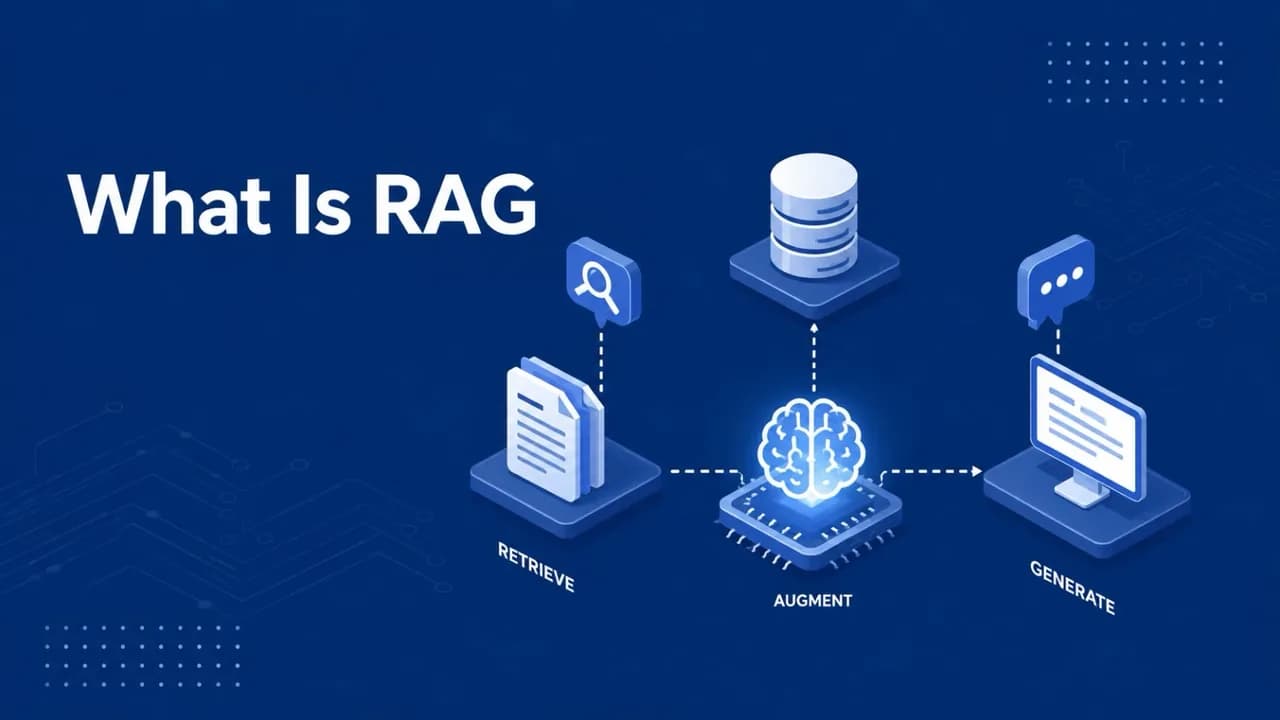
What Is RAG (Retrieval-Augmented Generation)?
RAG — Retrieval-Augmented Generation — is a method that makes AI systems smarter by connecting them to your actual business data before they generate a response.
Here’s the problem RAG solves: standard AI models like ChatGPT are trained on general internet data. They don’t know your company’s internal policies, product catalog, customer history, or proprietary documents. Ask them a company-specific question and they’ll either guess or hallucinate a wrong answer.
RAG fixes this. Instead of relying only on what the AI was trained on, RAG retrieves relevant information from your own data sources — documents, databases, knowledge bases — and feeds it to the AI at the moment it generates a response. The result: accurate, grounded answers based on your real data.
According to IBM, RAG reduces AI hallucinations by up to 50% compared to standard large language models operating without retrieval (Source: IBM Research, 2024). For businesses deploying AI, that accuracy gap is the difference between a useful tool and a liability.
How Does RAG Work?
RAG operates in three steps. Understanding this pipeline helps business leaders evaluate whether RAG fits their needs.
- Retrieve: When a user asks a question, the system first searches your company’s data sources — internal documents, knowledge bases, CRM records, policy manuals, product databases — and pulls the most relevant pieces of information. This uses a technique called vector search, which finds content by meaning, not just keyword matching.
- Augment: The retrieved information is combined with the user’s original question into a single prompt. The AI now has both the question and the relevant context it needs to answer accurately.
- Generate: The AI generates its response using the retrieved context as its source material. Instead of guessing from general training data, it answers based on your specific, current information.
A practical example: An employee asks your internal AI assistant, “What is our refund policy for enterprise clients?” Without RAG, the AI might generate a plausible-sounding but incorrect policy. With RAG, it retrieves your actual refund policy document, reads the enterprise client section, and gives the correct answer — with the source document linked.
According to a 2024 survey by Databricks, 63% of enterprises building AI applications chose RAG as their primary approach for grounding AI in proprietary data (Source: Databricks State of Data + AI Report, 2024).
RAG vs Fine-Tuning — What’s the Difference?
Businesses exploring AI often hear about both RAG and fine-tuning. They solve different problems.
| Factor | RAG | Fine-Tuning |
|---|---|---|
| What it does | Connects AI to your data at query time | Retrains the AI model on your data |
| Data freshness | Always uses current data | Frozen at time of training |
| Cost | Lower — no model retraining needed | Higher — requires GPU compute and expertise |
| Setup time | Days to weeks | Weeks to months |
| Best for | Knowledge bases, documents, FAQs, policies | Changing the AI’s tone, style, or specialized behavior |
| Updates | Add new documents anytime, instant effect | Retrain the model each time data changes |
| Hallucination risk | Lower — answers grounded in retrieved sources | Medium — can still hallucinate outside training data |
When to use RAG: Your business has documents, policies, knowledge bases, or data that changes regularly, and you need AI to answer questions accurately based on that data.
When to use fine-tuning: You need the AI to behave a specific way — adopt a brand voice, follow a specialized workflow, or handle domain-specific language patterns.
Many enterprise deployments use both. Fine-tune for behavior, RAG for knowledge. According to Andreessen Horowitz, 80% of enterprise AI applications in production use some form of retrieval-augmented approach rather than relying on model training alone (Source: a16z, 2024).
Why Businesses Need RAG in 2026
AI adoption is accelerating across every industry. But adoption without accuracy creates risk. RAG is how businesses get accuracy.
The hallucination problem is real. A 2024 Stanford study found that large language models hallucinate — generate factually incorrect information — in 15-25% of responses when operating without retrieval augmentation (Source: Stanford HAI, 2024). For a business using AI to answer customer questions, advise employees, or support decisions, that error rate is unacceptable.
RAG solves the three biggest barriers to enterprise AI adoption:
- Accuracy: Employees and customers need to trust AI responses. RAG grounds every answer in actual source documents, reducing hallucination rates dramatically.
- Data privacy: RAG keeps your proprietary data in your own systems. The AI retrieves from your databases at query time without your data being sent to external training pipelines. According to Deloitte, 62% of enterprises cite data privacy as their top concern in AI deployment (Source: Deloitte AI Institute, 2024).
- Currency: Business information changes constantly — new products, updated policies, revised pricing. RAG pulls current data every time, unlike fine-tuned models that are frozen at their last training date.
Real-World RAG Use Cases for Business
RAG is already deployed across industries. These are the use cases delivering measurable ROI.
- Internal knowledge assistants: Employees search across company wikis, policy documents, HR manuals, and onboarding guides using natural language. Instead of digging through SharePoint or Confluence, they ask a question and get an answer with the source document cited. McKinsey estimates knowledge workers spend 19% of their work week searching for internal information (Source: McKinsey Global Institute, 2024). RAG-powered assistants cut that dramatically.
- Customer support automation: AI chatbots connected via RAG to product documentation, troubleshooting guides, and account data provide accurate answers instead of generic responses. Support tickets requiring human escalation drop significantly.
- Compliance and legal research: Legal teams use RAG to query regulatory documents, contract libraries, and compliance frameworks. The AI retrieves specific clauses and precedents instead of generating plausible-sounding legal text that might be wrong.
- Sales enablement: Sales teams ask AI about product specifications, pricing structures, competitive comparisons, and case studies. RAG pulls from the latest product database and approved sales materials, keeping responses accurate and on-brand.
- Healthcare documentation: Medical professionals query clinical guidelines, drug interactions, and treatment protocols through RAG-powered systems, ensuring responses are grounded in approved medical literature rather than general AI training data.
Benefits of RAG for Enterprise AI
- Reduced hallucinations: AI answers grounded in actual documents, not guesses. IBM’s research shows up to 50% reduction in hallucinated content (Source: IBM Research, 2024).
- Lower implementation cost: No expensive model retraining. Connect your existing data sources and deploy. According to Gartner, RAG-based implementations cost 60-70% less than full fine-tuning approaches for knowledge-grounded applications (Source: Gartner, 2024).
- Real-time data accuracy: Add or update documents and the AI’s answers reflect changes immediately. No retraining lag.
- Source transparency: RAG systems can cite which document, page, or section they used to generate each answer. This builds trust and enables verification.
- Data stays private: Your documents remain in your infrastructure. The AI retrieves at query time without your proprietary data entering external training sets.
- Scalable across departments: One RAG infrastructure can serve HR, sales, support, legal, and operations, each connected to their relevant data sources.
Industries Using RAG Today
- Financial services: Banks and insurance companies use RAG for regulatory compliance queries, policy lookups, and customer advisory. JPMorgan, Morgan Stanley, and major insurers have deployed RAG-based internal assistants.
- Healthcare: Hospital systems and pharmaceutical companies use RAG to query clinical guidelines, drug databases, and patient care protocols. Accuracy is non-negotiable in healthcare, making RAG essential.
- Legal: Law firms use RAG to search case law, contracts, and regulatory filings. According to Thomson Reuters, 72% of legal professionals reported that AI-assisted legal research improved accuracy when grounded in verified document retrieval (Source: Thomson Reuters, 2024).
- Technology: Software companies use RAG for developer documentation assistants, internal engineering knowledge bases, and customer-facing support bots.
- Manufacturing: Maintenance teams query equipment manuals, safety procedures, and parts catalogs through RAG-powered systems, reducing downtime and error rates.
- Government: Public sector agencies use RAG to make large policy document libraries searchable and accessible to staff and citizens.
How to Get Started with RAG
Implementing RAG doesn’t require rebuilding your technology stack. Here’s the practical path:
- Identify high-value data sources. Start with the documents your team searches most: knowledge bases, policy manuals, product documentation, FAQs. These deliver the fastest ROI.
- Assess data readiness. RAG works best with well-structured, up-to-date content. Outdated or contradictory documents produce poor results. Clean your data before connecting it.
- Choose your architecture. RAG can run on cloud platforms (AWS, Azure, GCP) or on-premises for sensitive data. The choice depends on your security requirements and existing infrastructure.
- Start with one use case. Don’t try to RAG-enable your entire organization at once. Pick one department or workflow, prove the value, then expand.
- Measure and iterate. Track answer accuracy, user satisfaction, and time saved. Use feedback to refine retrieval quality and expand data sources.
Comptech Enterprises helps mid-size businesses implement RAG systems tailored to their specific data and workflows. From identifying the right use case to deploying a production-ready RAG pipeline, Comptech’s AI solutions team handles the technical complexity so your team can focus on using the tool, not building it.
Comptech’s AI audit evaluates your existing data sources, recommends the right RAG architecture, and delivers a phased implementation plan — typically with a first working prototype within 4-6 weeks.
FAQs About RAG
What does Comptech Enterprises’ RAG implementation include?
Comptech’s RAG service covers data source assessment, architecture design, pipeline development, testing, and deployment. Comptech connects your internal documents, knowledge bases, and databases to an AI system that answers questions accurately using your actual data. Ongoing support includes monitoring retrieval accuracy and expanding data sources as your needs grow.
Is RAG secure enough for sensitive business data?
Yes. RAG keeps your data in your own infrastructure. Documents are retrieved at query time — they’re not uploaded to external AI training sets. Comptech implements RAG with enterprise-grade security, including encryption, access controls, and audit logging. According to Deloitte, retrieval-based AI architectures are the preferred approach for 62% of enterprises with strict data governance requirements (Source: Deloitte AI Institute, 2024).
How much does RAG implementation cost compared to custom AI model training?
RAG costs significantly less than fine-tuning. Fine-tuning requires specialized GPU compute, data preparation, and ongoing retraining as data changes. RAG uses existing AI models and connects them to your data. Gartner estimates RAG-based deployments cost 60-70% less than fine-tuning for knowledge-grounded use cases (Source: Gartner, 2024). Comptech provides transparent project scoping so businesses know exact costs before starting.
Can Comptech Enterprises integrate RAG with our existing systems?
Yes. Comptech integrates RAG with common enterprise platforms including SharePoint, Confluence, Google Workspace, Salesforce, internal databases, and custom knowledge bases. The integration is designed to work with your current tech stack, not replace it. Comptech’s ISO 9001:2015 certified process ensures structured, documented implementations.
Conclusion
RAG is the technology that makes enterprise AI actually useful. Without it, AI systems guess. With it, they answer from your real data — accurately, privately, and in real time.
As AI adoption accelerates, businesses that deploy RAG-powered systems gain a measurable advantage: faster employee workflows, better customer support, and confident AI-assisted decision making.
Comptech Enterprises builds RAG solutions for mid-size businesses across Europe, Canada, Australia, and the UAE. If your team wastes hours searching for internal information, or your customers get generic AI responses instead of accurate ones, RAG is the fix.
Ready to put your own data to work? Contact Comptech Enterprises for a free AI audit → and discover how RAG can transform your business operations.
Mohit Negi
Lead AI Architect & Founder
Pioneering enterprise IT infrastructure and AI agent architectures at Comptech Enterprises for over 15 years.